

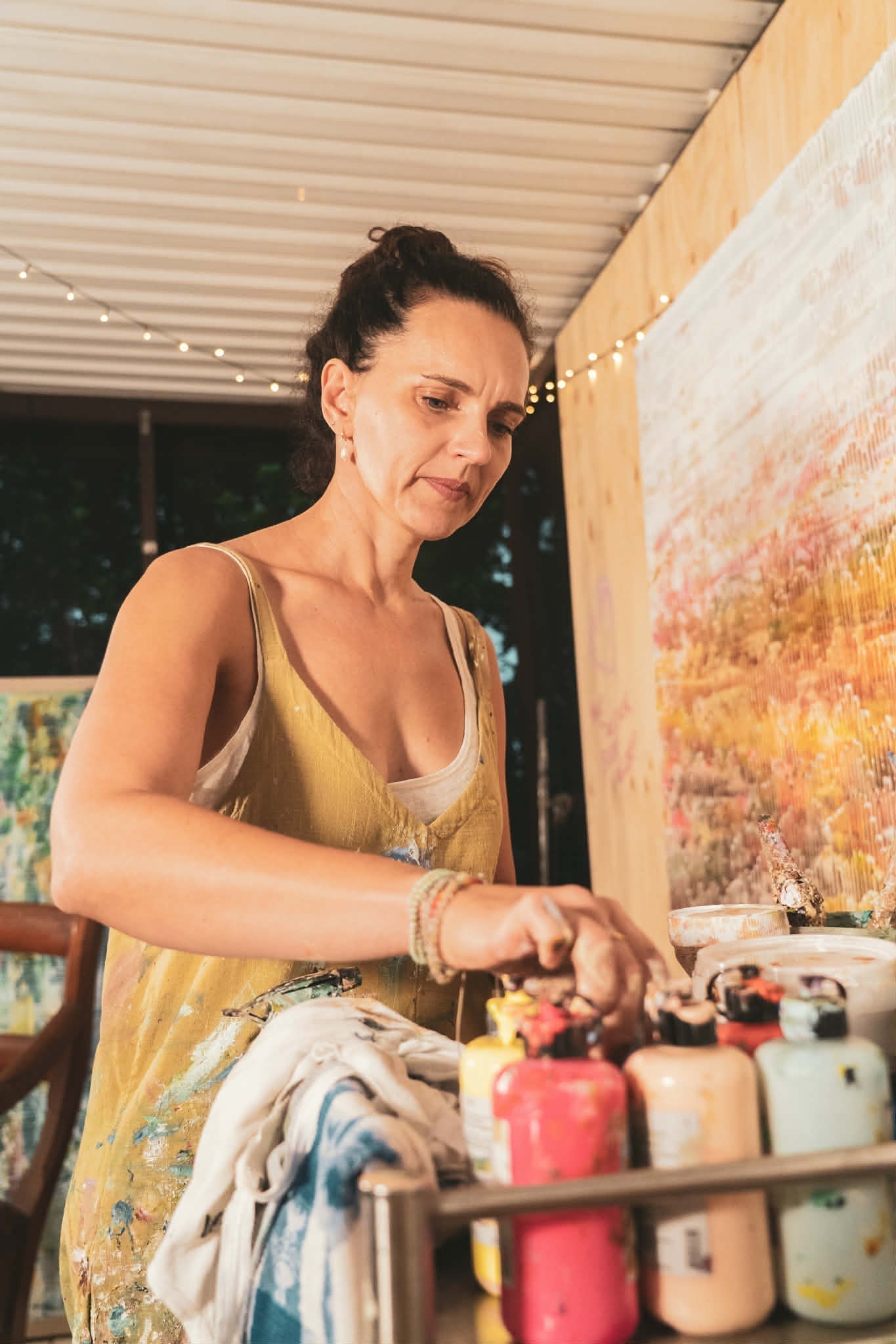
Waking Up in the Process: Painting Beyond the Ego
There’s a subtle tension that exists at the beginning of every painting.
It often starts with a thought:
What will this become?
Will it work?
Is this enough?
This is the voice of the mind, the part of us that wants clarity, control, and reassurance. It’s not wrong, and it’s not the enemy. In many ways, it’s protective. It wants things to feel safe, resolved, and understood.
But I’ve come to see that this voice can also keep me at a distance from something much deeper.
Because underneath that layer of thinking, there is another way of creating.
It doesn’t begin with an idea, but with a feeling.
A movement.
A quiet pull toward a colour, a gesture, a rhythm.
When I allow myself to follow that instead, without needing to know where it’s going, the process changes. Time softens. The work unfolds in a way that feels less constructed and more discovered.
This is what I think of as waking up within the act of painting.
Not in a dramatic sense, but in a gentle returning. A shift from thinking to sensing. From controlling to listening.
There are moments, even then, when the mind comes back in.
It questions a mark.
It hesitates.
It suggests stopping before things go too far.
And sometimes, those are the most important moments to move through. Because just beyond that hesitation is often where the work becomes most alive, where it moves beyond what I can predict or plan.
My practice is built on layers, repetition, and movement. These elements don’t allow for complete control. They ask for trust. They ask me to stay present.
Each painting becomes a conversation between these two states:
the part that wants to direct,
and the part that is willing to surrender.
Over time, I’ve learned that the most resonant works are not the most perfect ones, but the ones where I’ve stayed with that second state the longest.
Where I’ve let go, even slightly, of needing to get it right.
Because what remains in those works is not just an image, but an energy.
A trace of presence.
A record of returning.
A quiet kind of clarity.
And perhaps that’s what we respond to, not just in art, but in life.
Not the polished surface, but the feeling underneath it.


